








































































Why 1mm Matters in Clock Repair Kits and Movement Replacements
Author: Erin Crisci Date Posted:1 June 2026

In the world of horology, precision is crucial. In carpentry or landscaping, a millimeter might seem like a negligible measurement. In clock repair, it could mean the difference between a functioning timepiece and a mechanical failure. When you are sourcing a repair kit or a replacement movement, that single millimeter is very important.
Shaft Length, Dial Thickness & Dial Hole
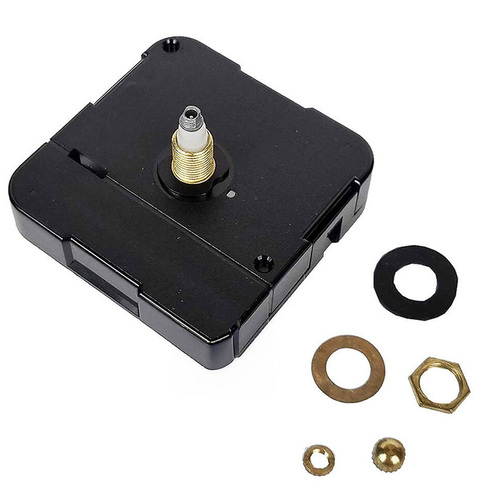
The most frequent pitfall in clock movement replacement lies in the shaft length (the part of the movement that passes through the clock dial). The look of the shaft may differ, some being threaded, and some being plastic. Most standard quartz movements come in shaft length increments that differ by just a few millimeters. Choosing the wrong size creates a cascade of physical obstructions.
Make sure to measure the shaft length of your old movement by measuring from the face of the movement to the very end of the shaft. This measurement is NOT the threaded part of the shaft, it is the entire shaft. Please note it is important to get accurate measurements.
If the shaft is just 1mm too short, the movement may not extend far enough through the dial, leaving you unable to secure the hands to the movement without dial interference. Conversely, if the shaft is 1mm too long, the hands may sit too far away from the dial, or the end of the shaft could touch the glass. Even the slightest friction against the glass will consume the energy needed to move the gears, causing the clock to lose time or stop entirely. If your clock does not have a glass or acrylic lens, you may need to consider a slightly longer shaft as this will provide a margin for error. This means the hands will simply sit further proud of the dial. These issues are subtle, but incredibly common.
Be sure to always measure the thickness of your dial and compare it precisely with the threaded shaft length, not the overall shaft length. A 1mm difference in dial thickness can change how securely the movement mounts. Too loose? The clock movement isn’t secure and shifts. Too tight? The threads may not engage properly. If your original movement doesn’t have a threaded section, you can still measure the dial thickness easily enough with a toothpick (or something similar). Poke the toothpick through the dial hole until the point is flush with the clock face, then mark the toothpick. Measure that against a ruler to find your dial thickness.
In addition, it is important to measure the dial hole diameter, which acts as the gateway for the entire assembly. Many antique clocks were built with narrow apertures. When upgrading to a modern movement, the diameter of the new center-bush is often slightly wider than the original. If you attempt to install a movement where the bushing is 1mm wider than the hole, you risk damage to the dial. On a porcelain or hand-painted tin dial, forcing the fit can cause cracking, destroying the aesthetic value of an heirloom that may have survived for a century or more. It’s important to understand the difference between movements that have threaded sections on the shaft, and movements without this thread. The threaded section’s diameter provides the minimum requirement for the dial hole. Generally, these threaded sections are approximately 8mm in diameter, so by ensuring your dial hole is at least 9mm, the threaded section can slot into the dial easily. The hex nut washer hex for the threaded section is generally 14mm in diameter, so it is not recommended to install a threaded movement on a dial that has a dial hole diameter of 13mm or more. The sweet spot would be between 9mm-12mm. If your original movement uses a threaded collar that screws down into the case of the movement instead of a hex nut, then your minimum dial hole diameter should be 10mm, and the maximum is generally 11mm. The best thing to do is to measure everything, from the diameter of the threaded section of the shaft, the original washer, or collar, whichever applies to your situation.
Hand Fittings
One might assume that clock hands are universal, but the interface where the hand meets the movement is a minefield of tiny measurements. There is a huge difference between "Press fit" and "Euroshaft" fittings, with press fit measurements alone often separated by a fraction of a millimeter. How to determine which type your hands are?
First, if your clock has a second hand, it presses onto a spindle in the clock movement. Carefully pull this second hand off by gently wiggling it as you pull it up and away from the clock dial.
Then look carefully to determine if your clock has a small nut that secures the minute hand. The nut can either be a closed nut (no hole in the middle) or an open nut (with a hole like a donut). Regardless of which type, unscrew this nut to release the minute hand. If you find there is something still protruding from the center of the minute hands once it has been removed, it is likely because a hand nut has not been unscrewed and the minute shaft has been pulled out of the movement. This is what is still attached to the minute hand.
If your clock does not have a small nut, then your minute hand will be a friction fit (press fit). Remove the minute hand by gently lifting it off the shaft.
Examine the hole in your minute hand. (Remember, there should not be anything protruding from the center of the minute hand.)
- If it is round or has a hexagonal looking eyelet, and if the hand pushes onto the shaft, then your hands are press fit hands, and you will need a press fit movement
- If the hole is slotted, in other words has two flat sides and round top and bottom, and it is held on with a small nut, then your hands are euroshaft / I-shaft hands, which use a euroshaft (I-shaft) movement.
- If your minute hand is over 160mm in length then we strongly recommend that you use a high torque movement
- Some clocks may have short hands, but these can be very thick and heavy. If your hands weigh over 8 grams, we recommend a high torque movement, which are designed to drive longer or heavier hands. Please note, a high torque movement is the same quality as a standard movement, they are not superior in any way.
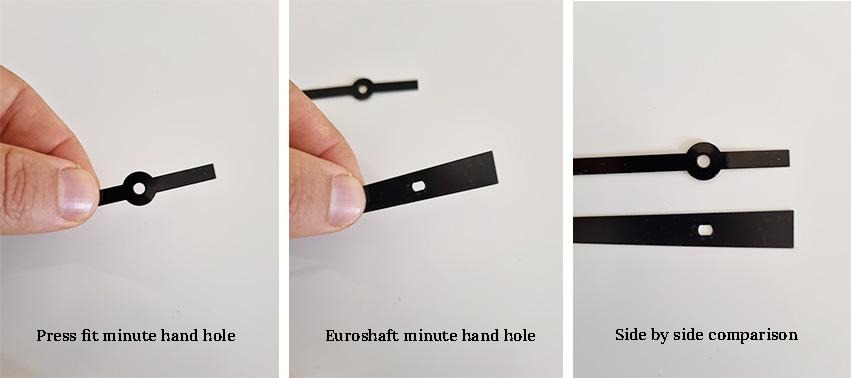
Clock hands attach to movement posts in specific sizes and formats (hour, minute, and second hands each have unique fittings).
A difference of 0.5mm in the hand hole diameter, and clearance from the dial can cause hands that won't press on, hands that fall off, or hands that rub together and stop the clock. One example of this is in our German UTS Euroshaft movements, where the minute hand dimensions are slightly smaller (3.5mm x 2.8mm), as opposed to a standard or Takane Euroshaft movement (4mm x 3mm). The hour hand dimensions are the same across the different Euroshaft movement types that we supply. This means that the German UTS hands wont fit on takane movements, due to the differences in hand hole dimensions, which only differ by under 1mm.
Precision ensures smooth, friction-free rotation.
Winding Arbors
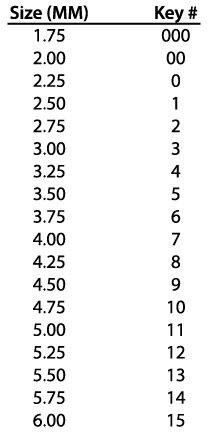
For those working on mechanical clocks, the winding key is often the primary point of contact. Clock keys come in different numbers (e.g No. 6 or No. 10). These numbers represent which size winding shaft your clock has, and therefore which key to purchase. If you don’t know what size key you require you’ll have to measure the ‘square’ of your winding shaft, then refer to the picture to purchase the relevant key. Use a vernier caliper to measure the key shaft in your clock, and make sure to order one size above your measured shaft size. Each key size is an increase of just 0.25mm so it is important to measure the square accurately.
The square winding arbor is designed to fit a specific key size with very little tolerance. Using a key that is 1mm too large might feel like it works initially, but it creates a "loose fit. Every time you wind the clock, the hardened steel of the key will shave off the corners of the softer brass arbor. This is known as "rounding over." Once the corners are gone, the key will simply spin without engaging the spring. Repairing a rounded arbor usually requires a complete teardown of the movement to replace the arbour, a costly consequence for failing to respect a single millimeter of difference.
Conclusion
Clocks are precision instruments. Their reliability depends on exact spacing, alignment, and fit. That tiny difference you can barely see can determine whether your clock runs perfectly for years… or doesn’t run at all.
So before you order your next repair kit or replacement movement, remember:
Measure twice. Choose carefully. Because in clock repair, 1mm truly matters.